In the falling light
In Kyoto, the light was failing me. Or maybe it was the other way around.
It was day six of my photography assignment, and I had nothing. I’d walked the old capital for hours, camera in hand, trying to capture the spirit of old Japan. I’d shot hundreds of frames, with rickshaws, temples, autumn trees, but all of them felt lifeless. I kept walking and pressing the shutter anyway, hoping to salvage the day.
The critic in my head grew louder with each missed shot. Who do you think you are? They actually paid you to come here? You’re going to disappoint everyone.
It was my first travel photography assignment, something I’d dreamt of doing for years. But now the images I’d imagined making were turning into a different kind of image: me coming home with insipid photos, my sponsors furious, my credibility dissolved.
Maybe I shouldn’t have tried at all.
I’d always been someone who stayed close to what I was already good at. Things that came easily, which let me feel smart from the start. Growing up, I’d absorbed the idea that talent was a birthright. You either had it, or you didn’t.
I was afraid to try new things, because trying meant possibly failing, and failing meant proving what I feared most. That I didn’t have it in me.
Psychologist Carol Dweck calls this the “fixed mindset”: a belief that abilities are fixed and failure sets one’s boundaries. But she also describes something else: the “growth mindset”, the idea that abilities can be expanded. A mindset that treats failure as a lesson, not a verdict.
I wasn’t sure if I believed it. But I tried with photography.
At the beginning, it seemed to confirm that I was indeed hopelessly untalented. My photos came back from the printer blurry, unfocused, boring. Or worse, I covered most of a school event, only to have another photographer point out that my settings were underexposed. The photos came out pitch dark.
But I kept going. I devoured books, took courses, wandered through galleries. I remember struggling with getting sharp images – how holding the camera, setting the right shutter speed and aperture felt like juggling with glass. When I finally nailed it, I read with delight that you could use motion blur too, to tell a different kind of story.
That evening in Kyoto, with nothing to show for the day, the voice of doubt returned. The sun was setting. My feet hurt, and I was growing hungry. Perhaps it was time I called it quits.
Then I noticed something – I’d been shooting the rickshaw drivers all day, but the daylight had flattened the images. Now, with the sun setting and the lanterns glowing, there was colour and contrast. Maybe this was my chance.
I set up near a backdrop I’d scouted earlier and waited.
The first rickshaw passed, and I pressed the shutter. It was close, but the passengers wore a suit and a dress. It didn’t evoke the old-world feeling I was after. Then another rickshaw came into view. The passengers were in traditional kimonos. The light was almost gone. It would soon be too dark for the camera to capture anything.
They came closer.
I raised the camera and snapped.
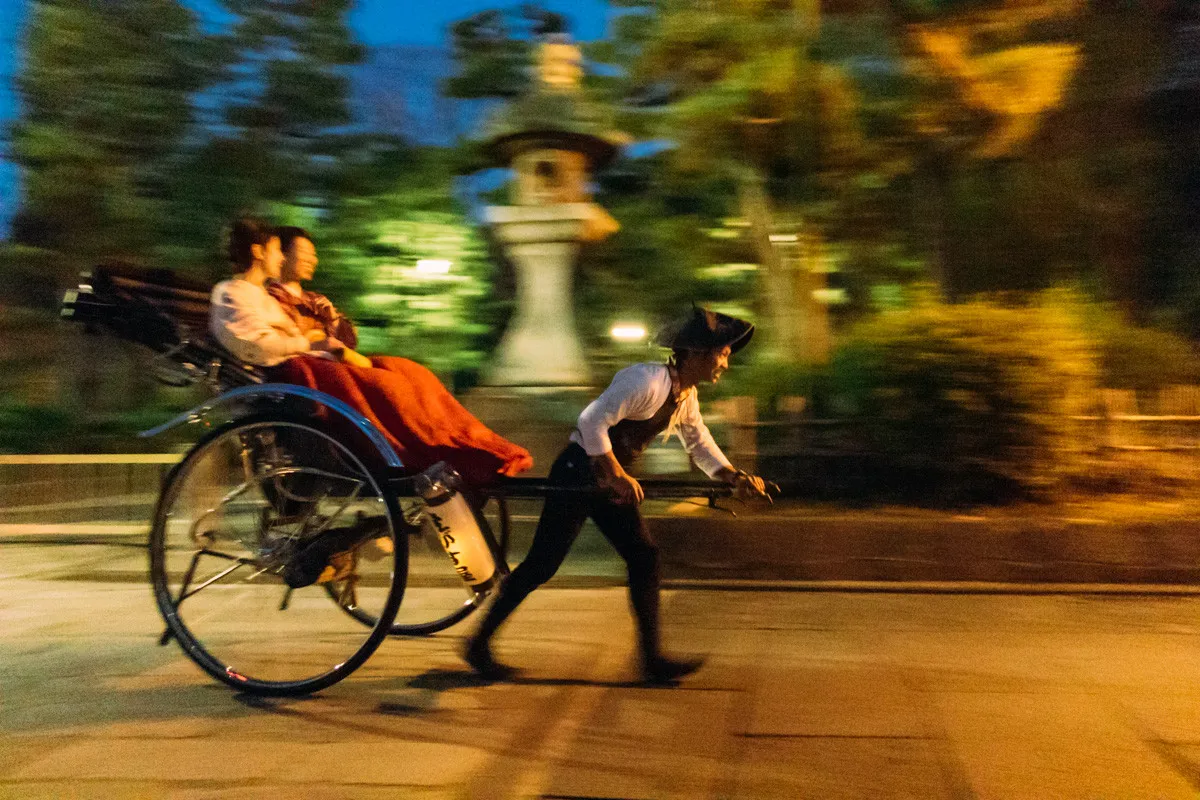
Kyoto, Japan. November 27, 2014.
The resulting photo was grainy and slightly blurry. But it felt alive. I stared at the preview screen, my hands trembling slightly. The day hadn’t been wasted after all. I packed up and walked into the night for dinner, stomach growling, heart full.